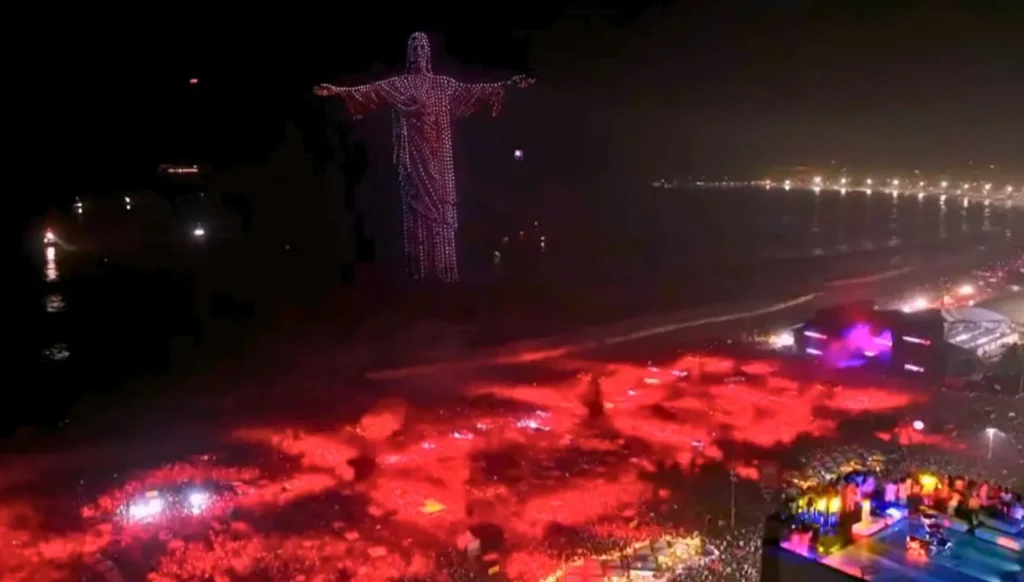
Drones, public space and electronic music at unprecedented scale
On New Year’s Eve in Rio de Janeiro, electronic music once again operated beyond traditional boundaries. At Copacabana Beach, Alok delivered a large-scale performance combining music, aerial drone choreography and city-level infrastructure, transforming the shoreline into a temporary cultural stage.
The show featured a synchronized fleet of 1,250 drones, one of the largest deployments of its kind ever seen in Latin America. Throughout the performance, the drones projected symbolic imagery into the night sky, including the Christ the Redeemer statue rising from the sea, Sugarloaf Mountain, the word “Rio” accompanied by a red heart, and a “Happy 2026” message. The visuals framed the set not as a club performance, but as a public ritual.
Scale Beyond the Stage
According to the City of Rio de Janeiro, approximately 2.6 million people gathered in Copacabana alone, while overall New Year’s Eve celebrations across the city reached an estimated 5.1 million attendees, including residents and international visitors. The event was later recognized by Guinness World Records as the largest New Year’s Eve celebration in the world.
At this scale, electronic music no longer functions as a nightlife format. It becomes infrastructure-dependent, requiring coordination between public authorities, safety operations, sound engineering, drone aviation teams, pyrotechnics and broadcast logistics.
The performance included lasers, fireworks and large-format visuals designed for mass visibility rather than intimacy. The programming reflected this reality: continuity, recognizability and collective impact took priority over experimentation.
From DJ Set to Civic Moment
During the set, Alok was joined on stage by vocalist Zeeba for a live performance of “Hear Me Now,” reinforcing the crossover between electronic music and mainstream public audiences. The appearance marked a moment of familiarity within a night built for scale rather than subcultural depth.
The broader evening contextualized the shift. Prior to midnight, the main stage hosted performances by Gilberto Gil alongside other Brazilian music icons, positioning electronic music within a lineup traditionally reserved for nationally symbolic artists.
What This Signals
Copacabana’s New Year’s Eve celebration illustrates how electronic music has been absorbed into civic spectacle. DJs now occupy roles once associated with pop headliners or national cultural figures, especially during moments of symbolic importance such as the turn of the year.
The use of drone technology, public landmarks and mass attendance reframes the DJ performance as part of urban storytelling. Music becomes one layer within a larger narrative built on identity, scale and visibility.
This was not a club night.
It was not a festival.
It was electronic music operating at city scale.